

1. Abstract
For many VPS users, "CN2" is a key term during the selection process. You will often encounter providers aggressively marketing their products under the "CN2" banner. However, faced with a market flooded with such claims, have you ever wondered: Is this a genuine CN2 line? How does it actually perform? Is it worth the investment? When choosing a VPS—especially for users with high network quality requirements—the ability to distinguish between "Real vs. Fake CN2" is an indispensable skill.
As an experienced user, I have seen far too many people run into unnecessary trouble because they couldn't accurately verify their connection. Today, I’m sharing this detailed visual guide to help you identify genuine CN2 lines and avoid falling into the traps of false advertising.
2. Understanding the Basic Characteristics of CN2
Before we verify authenticity, we must have a clear understanding of CN2's technical profile. A pure CN2 line has several distinct technical traits we can use as benchmarks.
2.1 Routing Node Characteristics
The most reliable indicator of a true CN2 line is the IP segments observed during a traceroute. Genuine CN2 traffic passes through nodes within the 59.43.x.x IP range. This is China Telecom's dedicated backbone segment and a unique signature of CN2. If you see this segment in your routing results—and the reverse DNS (PTR) record points to chinatelecom.cn—you can be reasonably certain it is a CN2 line.
2.2 Latency Performance
When accessing a Chinese server from the US or other overseas locations, a healthy CN2 line typically maintains a ping latency of around 150ms. Specifically, connections from the US West Coast to Mainland China can even drop to 120–140ms. For Hong Kong to Mainland China routes, latency is usually kept under 30ms. These are the significant advantages of CN2. Note: Latency alone is not a definitive proof, as it is influenced by network architecture and physical distance. The most important factor is the stability of the routing path and the quality of the nodes.
2.3 Triple-Network Optimization (3-Way Peering)
Another hallmark of CN2 is its optimization for China's three major carriers: China Telecom, China Unicom, and China Mobile. Unlike standard lines that may only favor one provider, CN2 provides a consistently stable experience regardless of which carrier the end-user is using.
3. Hybrid CN2 Lines: Why Do They Exist?
You might wonder why "Hybrid CN2 Lines" are so common. This essentially boils down to a balance between network architecture and cost. To lower expenses, many VPS providers use hybrid setups where only a portion of the traffic is routed through CN2. This means during off-peak hours, traffic might use traditional lines, only switching to CN2 when the network becomes congested or unstable.
3.1 Differences: Hybrid vs. Pure CN2
Stability: Pure CN2 (especially GIA) is significantly more stable because it remains on premium routes at all times. Hybrid lines may experience latency spikes or packet loss during peak hours.
Performance: CN2 GIA performs consistently during peak periods (like evening hours in China), whereas hybrid lines may fluctuate during automated route switching.
Price: This is the most obvious indicator. Pure CN2 GIA is expensive due to high costs, while hybrid lines are much more affordable.
4. How to Verify CN2 Authenticity?
Relying on a provider's marketing is not enough; we need to use technical tools to verify the routing path ourselves.
4.1 Outbound Traceroute
An outbound traceroute tracks the path from your client (e.g., your home or office network) to the VPS server. We can use traceroute tools to inspect this path.
Operational Steps:
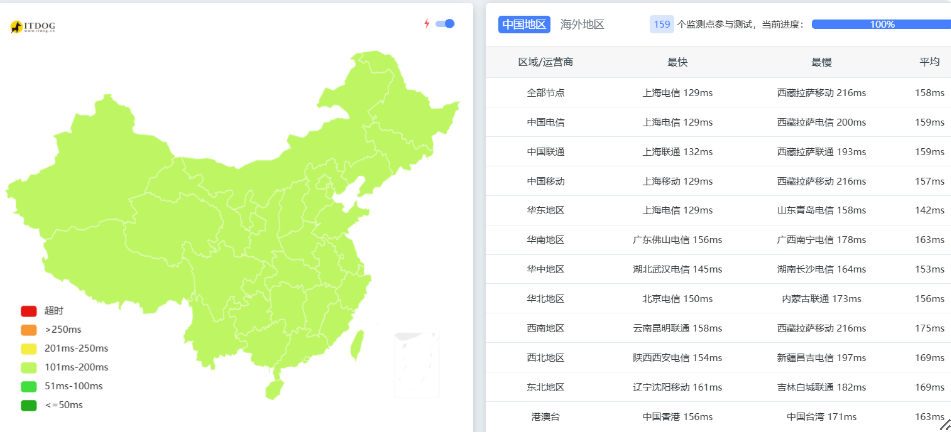
Use an online tool like ITDog for testing. Navigate to:
https://www.itdog.cn/traceroute.Enter your VPS IP address and select a testing region (ideally the city where you or your primary users are located).
Click "Start Test" and examine the detailed hop counts and node information.
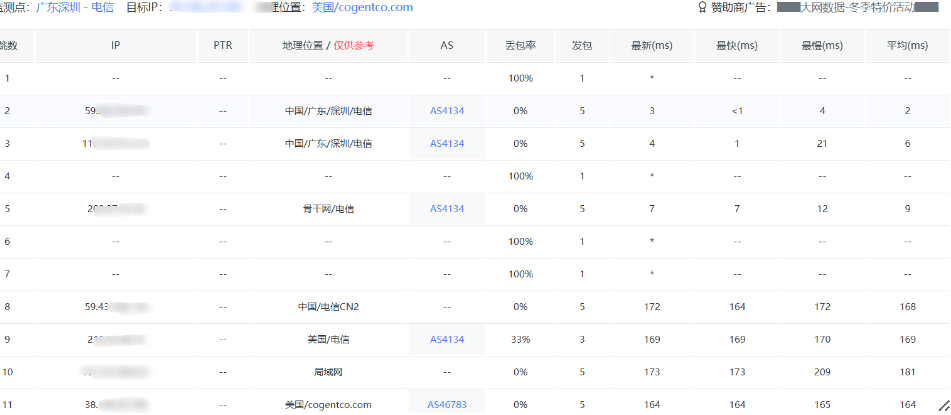
Outbound Routing Characteristics:
Distinct IP Segments: A genuine CN2 line will clearly display
59.43.x.xIP segments within the routing path.Reverse DNS Verification: The routing nodes' reverse DNS (PTR) records will typically resolve to
chinatelecom.cn.Low Hop Count: True CN2 routes are highly efficient, usually consisting of fewer hops—typically not exceeding 15 hops.
Warning Signs: If you see a high concentration of
202.97.x.xsegments (the hallmark of the traditional ChinaNet/163 Backbone), proceed with caution; this likely indicates it is not a pure CN2 line.
4.2 Inbound (Return) Traceroute
Inbound routing refers to the path data takes from your VPS server back to your local network (home or office). Testing the return path provides a more accurate reflection of the actual user experience.
Operational Steps:
Connect to your VPS server via SSH.
Execute the following command to test the return route to your home network:
Bash
traceroute [Your_Home_IP_Address]You can also test the return path to other domestic servers:
Bash
traceroute [Domestic_Server_IP]
The Importance of Inbound Routing:
Inbound routing helps you evaluate how well a VPS provider has optimized their return paths. When testing the route back to Mainland China, you can see directly whether it utilizes the CN2 network.
In a previous test, I discovered that a single VPS could have completely different routing policies for different destinations: it used a CN2 line for home broadband but reverted to the traditional 163 Backbone (AS4134) when connecting to a domestic cloud server. This discrepancy serves as a reminder that even "CN2-enabled" lines do not guarantee CN2 routing for all destinations.
Test Result Comparison:
When I used the traceroute command to test the path back to my home residential IP:
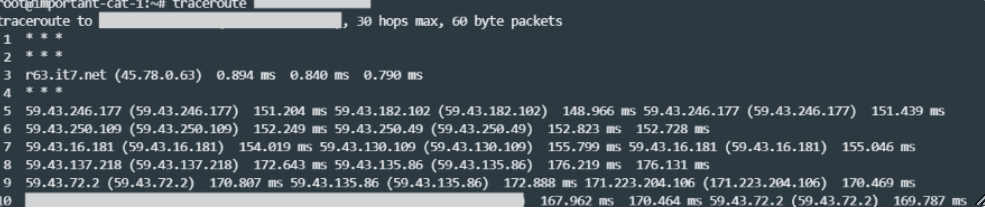
However, when I tested the domestic server IP address:
traceroute to 47.94.xxx.xxx
 1  10.0.0.1 (10.0.0.1)  0.892 ms
 2  172.245.xxx.xxx  1.234 ms
 3  202.97.33.1  25.678 ms  #
 4  202.97.63.174  45.234 ms
 5  202.97.90.146  165.567 ms
5. Case Study & Analysis
During my testing, I once encountered a provider claiming to offer "CN2 lines," yet multiple routing tests revealed significant instability. At certain times, the traffic utilized the CN2 network, but during other periods, it reverted to the traditional 163 Backbone. This clearly demonstrates that even when a provider brands their service as "CN2," it may actually be a "Hybrid Line." Therefore, it is crucial to perform multiple tests across different time slots—especially during peak hours—to verify the consistency and stability of the network quality.
6. Conclusion & Recommendations
I hope this guide has provided you with a clearer understanding of how to verify the authenticity of CN2 lines. Remember: actual testing is paramount; never rely solely on a provider's marketing materials. By performing both outbound and inbound traceroutes, you can gain a transparent view of the VPS network quality and avoid being misled by false advertising.
Be Skeptical of Pricing: If you find a "CN2" line that is unusually cheap, it is likely a hybrid route or not CN2 at all.
Prioritize Stability: When choosing a provider, do not blindly chase the lowest price. Always consider network quality and long-term stability.
Proven Recommendations: In my years of experience, veteran providers like VMRack and DMIT offer CN2 lines that are not only stable but also deliver guaranteed performance with excellent value for money. If you have high requirements for network quality, investing in their CN2 services is a wise decision.
Hopefully, this tutorial helps you make more informed decisions during your VPS selection process and keeps you from falling into common traps!